
What Is an Applicant Tracking System (ATS)? How It Simplifies Hiring
An applicant tracking system (ATS) brings applications, candidate information, assessments, interviews, and hiring decisions into one place. It can reduce recruitment admin and make hiring more consistent, but faster hiring isn't necessarily better hiring. The best systems help teams assess candidates against clear criteria, understand the evidence behind decisions, and keep people in control. As hiring becomes more complex or volumes increase, an ATS can give your team the structure to manage it without losing sight of the people you're trying to hire.

On this page
An applicant tracking system (ATS) is a recruitment software that gives the hiring process some structure. It keeps applications, candidate information, interviews, and hiring decisions in one place, making recruitment easier to manage as your team grows.
Hiring is relatively easy to manage when you’re filling one or two roles. But as a business grows, that changes quickly. More candidates, more hiring managers, and more open positions mean more opportunities for good people to fall through the cracks of your manual hiring process.
But the software is only part of the answer. I’ve always believed the goal of hiring isn’t to process more candidates. It’s to find the best person for the role. A good ATS should make that easier, helping you look beyond the usual talent pool, consider great people wherever they are, and make better hiring decisions.
In this guide, we’ll look at how an ATS works, where it adds value, what it costs, and how to implement one successfully.
TL;DR: An applicant tracking system (ATS) brings applications, candidate information, assessments, interviews, and hiring decisions into one place. It can reduce recruitment admin and make hiring more consistent, but faster hiring isn't necessarily better hiring. The best systems help teams assess candidates against clear criteria, understand the evidence behind decisions, and keep people in control. As hiring becomes more complex or volumes increase, an ATS can give your team the structure to manage it without losing sight of the people you're trying to hire.
What Is an Applicant Tracking System (ATS)?
An applicant tracking system (ATS) is a hiring software that helps businesses manage candidates throughout the hiring process, from application to offer. It keeps candidate information, interviews, feedback, and hiring decisions organized in one place.
An ATS is primarily about managing applicants, which distinguishes it from other recruitment tools. Job boards attract candidates, candidate relationship management (CRM) systems help build talent pipelines, and an HRIS manages people once they become employees.
|
Tool |
Primary purpose |
|
ATS |
Manage candidates through the hiring process |
|
CRM |
Find and nurture potential candidates |
|
Job board |
Attract applicants to open roles |
|
HRIS |
Manage employee information and HR processes |
The lines are starting to blur as recruitment platforms bring more of these capabilities together. And I think that's a good thing. The point isn't simply to manage applicants more efficiently. It's to give yourself the best possible chance of finding and hiring the right person.
How Does an ATS Work?
An applicant tracking system brings the hiring process into one place, from posting a role to making an offer. An ATS’s features will help your team manage each stage, but the real value is that the process, candidate information, and hiring decisions stay connected.
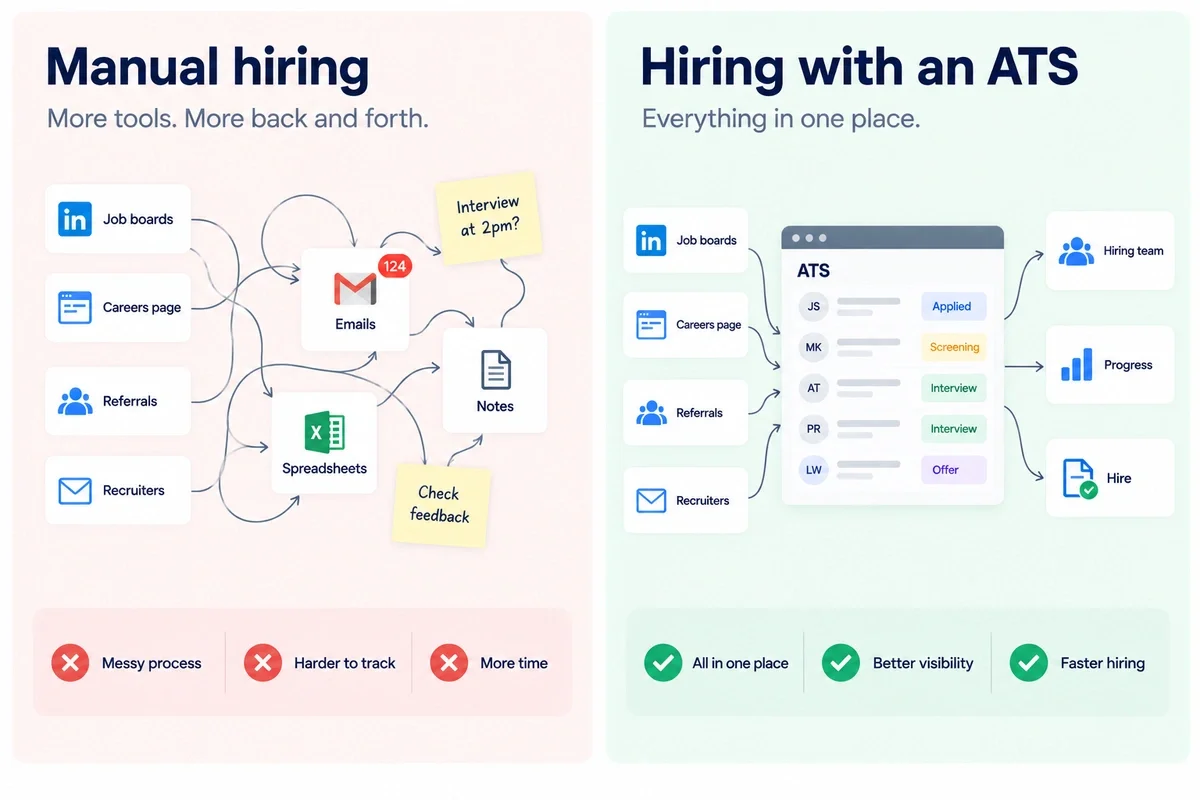
Moreover, I think that an underrated value of having an ATS is consistency. When every candidate follows a clear process and is assessed against the same criteria, you've got a much better foundation for making good hiring decisions.
information, and evidence stay connected. That means less administration and fewer opportunities for good candidates to get lost along the way.
From Application to Shortlist
An ATS collects applications in one place and helps your team screen, assess, and organize candidates as they move through the hiring process.
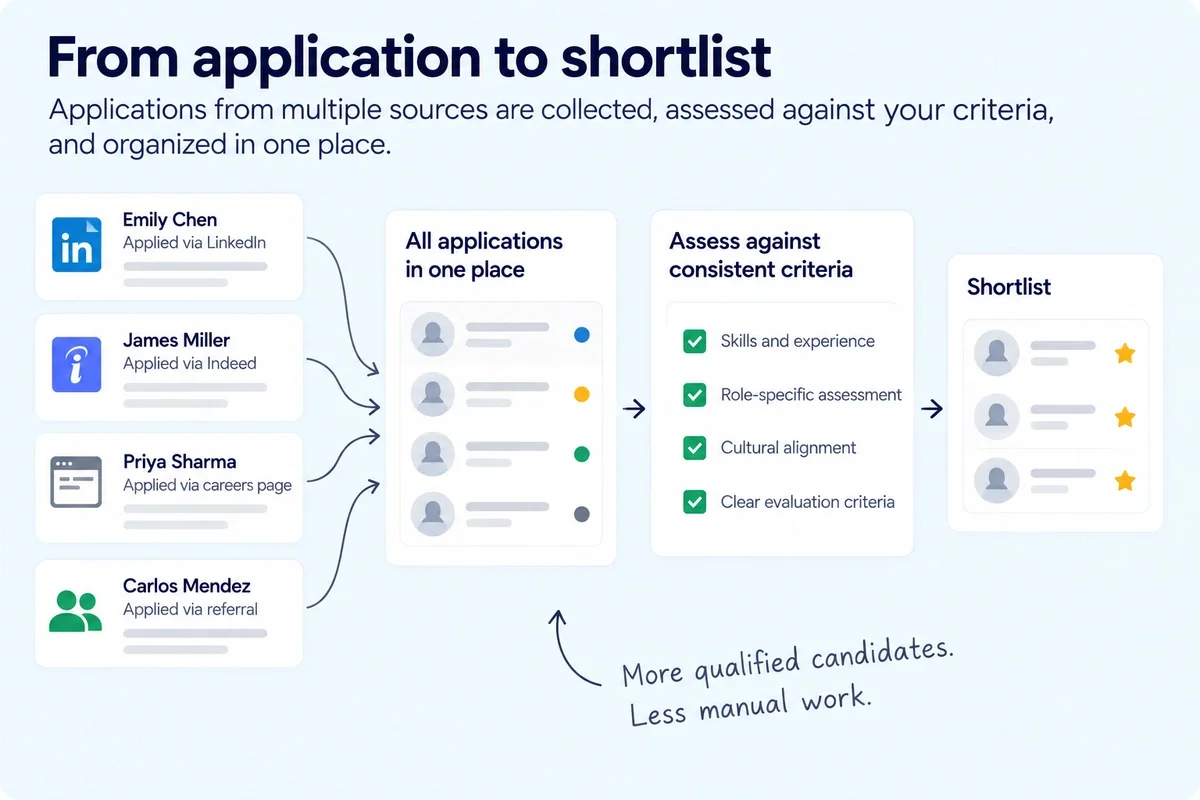
With ImpactHire, you can define what you're looking for upfront and assess candidates against those criteria. The evidence behind the scores remains visible, so your team can understand why a candidate performed well rather than relying on a black-box recommendation.
From Shortlist to Hire
As candidates move forward, an ATS keeps interviews, feedback, assessments, and next steps connected. It can also take care of repetitive work such as candidate emails and workflow actions.
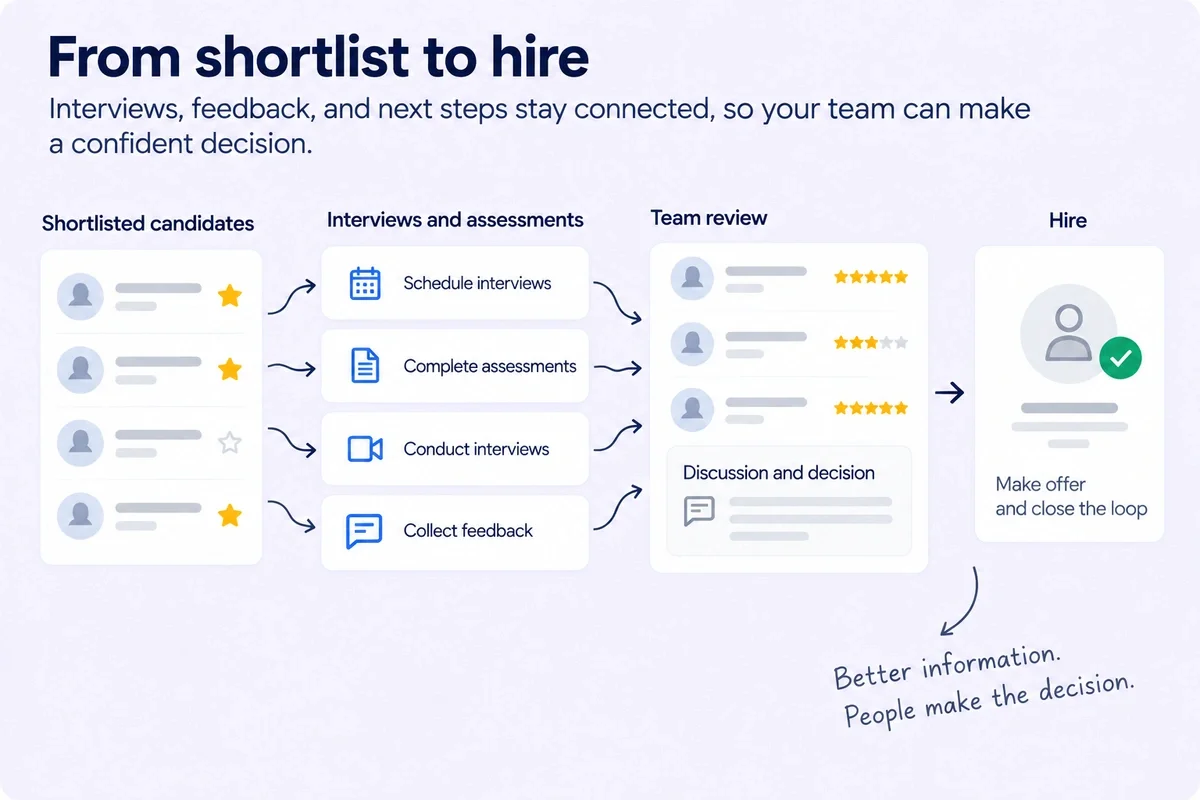
I've always thought technology should make hiring decisions easier, not make the decision for you. That’s exactly why we built ImpactHire. Our principle is that scores can help candidates move through a workflow, but the decision to reject or hire remains with people.
What Are the Benefits of an ATS?
The main benefits of an applicant tracking system come down to making hiring easier to manage and decisions easier to make:
- Centralized candidate management: Keep applications, assessments, interviews, feedback, and decisions in one place.
- Less recruitment administration: Automate repetitive work such as emails, scheduling, screening, and workflow management.
- A more consistent hiring process: Give candidates a clearer process and assess people against the same criteria.
- Better collaboration: Give recruiters, hiring managers, and interviewers the same view of each candidate and the evidence behind them.
- Better recruitment visibility: See where candidates come from, how they're progressing, and where the hiring process is slowing down.
For me, the real value is what happens beyond the software itself: less time spent managing recruitment, lower hiring costs, and better hiring decisions. Those are also the things that tend to shape the business case for an ATS.
When Does Your Business Need an ATS?
Your business needs an ATS when hiring becomes too complex to manage effectively through email, spreadsheets, and manual processes. Or simply put: you probably need an ATS when the way you've always managed hiring starts getting in the way of hiring well.
At first, email and spreadsheets can work perfectly well. But as hiring grows, the signs that you've outgrown them become fairly obvious:
|
If this is happening... |
An ATS can help by... |
|
Applications are spread across inboxes and spreadsheets |
Keeping candidates in one place |
|
You're hiring for several roles at once |
Giving you a clear view of each hiring pipeline |
|
More hiring managers are involved |
Keeping feedback and candidate information together |
|
Candidates are assessed differently |
Creating a more consistent process |
|
Good candidates are getting missed |
Making it easier to track who needs attention |
|
Recruitment admin is taking too much time |
Automating repetitive parts of the process |
|
You're managing high-volume or seasonal hiring |
Handling more candidates without adding the same amount of admin |
I've found the important signal isn't company size but its complexity. If your team is spending more time keeping track of candidates than actually evaluating them, an ATS starts to make sense.
How Much Does an Applicant Tracking System Cost?
The cost of an applicant tracking system varies considerably depending on the platform, the size of your team, your hiring volume, and the features you need.
|
Pricing model |
How it works |
|
Per user |
Based on the number of people using the ATS. |
|
Per job |
Based on the number of active roles. |
|
Usage-based |
Based on applications, assessments, interviews, or other activity. |
|
Subscription |
A monthly or annual fee based on your plan and features. |
The pricing model matters almost as much as the headline price. A system that looks inexpensive can become costly as your hiring volume grows, while another may include assessments, interviews, or automation that you'd otherwise need separate tools for.
I wouldn't look at price in isolation. The better question is what the system gives you for the cost and whether it reduces the time and administration involved in hiring. Once you understand what you need, it becomes much easier to compare applicant tracking systems based on what you're actually getting for the cost, rather than price alone.
What Does Switching to an ATS Look Like?
Switching to an ATS usually means taking the recruitment process you already have and bringing it into one system. Good ATS implementation starts with understanding what needs to move, what needs to change, and how your team will use the new system.
Most businesses will need to think about:
I've found a switch like this is also a good opportunity to question the process you already have. There's little value in moving an inefficient recruitment process into better software.
What Are the Limitations of an ATS?
I've always believed technology should help people make better hiring decisions, not make those decisions for them. When thinking about how to choose an ATS, I'd look beyond the feature list and ask how much visibility, consistency, and human control the system actually gives your hiring team.
I've always believed technology should help people make better hiring decisions, not make those decisions for them.That's why transparent AI hiring matters: hiring teams should understand how candidates are being assessed, see the evidence behind the results, and remain in control of the final decision. That's the balance we've tried to build into ImpactHire: automate what makes sense, make the evidence visible, and keep people in control.
Is an Applicant Tracking System Worth It?
An applicant tracking system is worth considering when hiring becomes difficult to manage manually. It can bring applications, assessments, interviews, feedback, and hiring decisions into one place, giving your team a more consistent way to hire.
But the software should do more than make recruitment faster. I've always believed the goal is to help people make better hiring decisions. That means giving hiring teams useful evidence, reducing unnecessary administration, and keeping people in control of the decisions that matter.
That's the thinking behind ImpactHire. We've built it to help businesses manage hiring from application to offer, with structured assessments, transparent scoring, and human oversight built into the process.
If you're looking for a better way to manage hiring and find the right people, talk to one of our strategists to see how it could work for your team.
Frequently Asked Questions About Applicant Tracking Systems
What does ATS stand for in recruitment?
ATS stands for applicant tracking system. It refers to software used by businesses and recruitment teams to organize and manage candidates throughout the hiring process.
Who uses an applicant tracking system?
Applicant tracking systems are commonly used by recruiters, talent acquisition teams, HR teams, and hiring managers. Different people may use the system to review candidates, conduct interviews, leave feedback, or manage different stages of recruitment.
Can an ATS post jobs to job boards?
Many applicant tracking systems can publish or distribute vacancies to job boards and other recruitment channels. This allows hiring teams to manage job postings and incoming applications from a central system.
Does an ATS integrate with other recruitment tools?
Many applicant tracking systems connect with tools such as job boards, calendars, assessment platforms, HR systems, and communication tools. The integrations available depend on the ATS.
How does an ATS process a resume?
An ATS can extract information from a resume and organize it into structured candidate data. This can include details such as work experience, education, skills, and contact information, making applications easier to review and manage.
Written by

Geoff has led the charity Beyond Orphanage for 25 years, an experience that shaped his commitment to fairer access to opportunity. This philosophy underpins Work for Impact, the world’s first global talent partner to achieve B Corp certification. Through his blog, Geoff shares insights on remote hiring, global team leadership and the future of work.